I am a Judge for the Singapore Engineering Innovation Challenge. This is my Guide for Aspiring Innovators

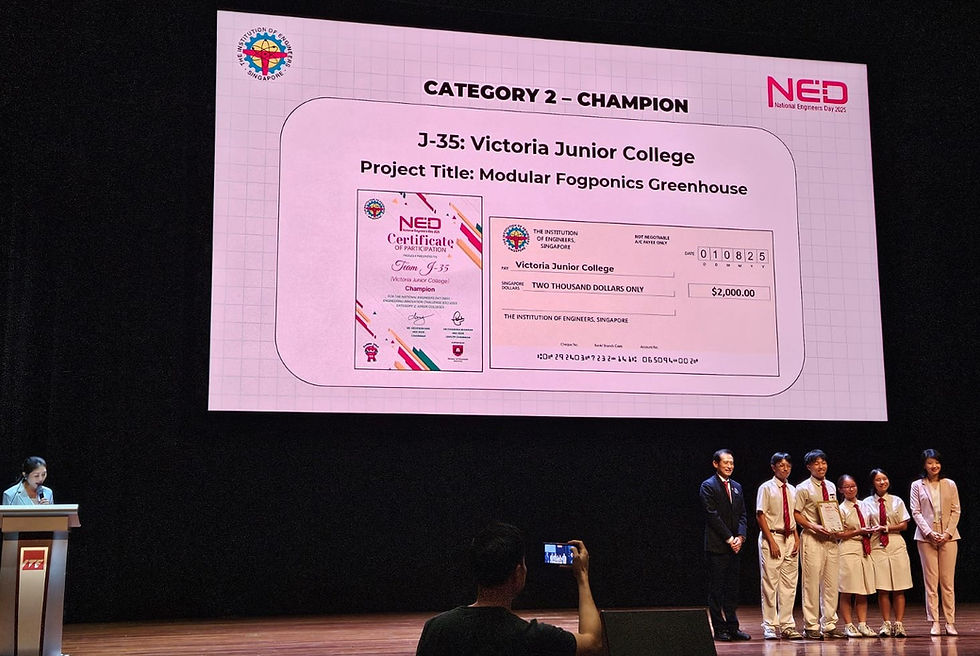
If you’re an Engineering and Technology Programme Scholarship (ETPS) student or any aspiring STEM innovator, the Engineering Innovation Challenge (EIC) is more than just another competition. It’s a pivotal opportunity encouraged by MOE for you to sharpen your hands-on creativity abilities to build an outstanding portfolio apart from your school grades. As a bonus, you get to stand out when applying to Ivy League, Oxbridge, and other top global universities. Combine EIC experience with STEM Olympiad achievements, and you will have a truly formidable university and scholarship application.
As a judge, a professional engineer and a Ryse Education consultant, I have seen firsthand what sets winning teams apart. Nothing beats a working prototype. It’s living proof that your bright idea translates into real-world solutions. But it’s not easy: The organizer intentionally sets tight budget constraints to test teams to focus relentlessly on core functionality and to make every dollar count. The best projects are those that solve a problem well, not just those that look the most impressive (e.g. by buying off the shelf which will definitely have your prototype marked down).
Tips for your team
The skillsets you and your teammates need:
Master Arduino and microcontrollers: They are the backbone of student prototypes.
Develop app/master web programming, especially for IoT/Bluetooth integration: Your prototype becomes truly impactful when it interacts with the world. In today’s context, this means connected to/controlled by the phone/tablet/laptop wirelessly.
Hone your soldering skills: A reliable, neat circuit is critical under competition pressure.
Get comfortable with CAD and 3D printing: Rapid iteration is your best friend for refining design at low cost.
Don’t forget: your environment matters too. Make sure your school backs you up with an equipped makerspace, soldering tools, computers loaded with CAD and coding software and access to 3D printers. Otherwise, even the best ideas struggle to get off the ground. These resources distinguish average teams from outstanding ones.
And while technical know-how is crucial, soft skills matter just as much. A top team mindset also matters: build, test, fail, learn, and repeat. The best prototypes go through cycles of iteration, improving with every round. But don’t forget storytelling! How you explain your idea, your innovation, and the positive impact it can bring is what sets you apart when judges are choosing who to reward and who to pass over. Build a team of diverse skills, seek mentorship early, and pack your final report with real lessons learned from the experience. Every round of testing and feedback helps you build a better product and a sharper portfolio narrative.
Final note:
As a seasoned STEM educator and professional engineer, I have guided many students to various STEM competition success and elite university admits. If you are serious about EIC, STEM pathways, or want tailored support crafting a portfolio that impresses even the toughest admissions panels, reach out.
The EIC is not just about winning. It's a proving ground for your problem-solving skills, resourcefulness, teamwork, and the passion you bring to STEM. For ETPS scholars and STEM majors hopefuls, EIC can be a huge boost to your candidacy for elite university admissions. Embrace the process, turn constraints into creative success and make sure you can say: “I built that. And it works.”


